Learn Kubernetes Weekly issue 195 · 5 Aug 2026
Audit Log Baselining, AI Agent for SRE Ops, Open Source Security Console, User Namespace Implementation, No Downtime VLAN Migration
This issue is brought to you by daily.dev — where developers discover what's next.
Articles
Practical Detection Engineering for Kubernetes: Baselining Audit Logs
substack.com
This article explains how Kubernetes audit log baselining detects credential abuse by focusing on what users access instead of how much they do, using namespace and resource patterns to spot anomalies.
We built an org-wide AI agent in 4 days. Here's what broke in the weeks after.
daily.dev
The story of building 'Smith', a 29K-line TypeScript AI agent integrated into our Slack workspace in just 4 days using Codex.
Learn about the production incidents and security challenges that followed.
sponsored
medium.com
This article explains how to design an AI agent for SRE operations that reads alerts, logs, Kubernetes data, runbooks, deployments, and observability signals to diagnose incidents and propose safe actions.
Building an OSS Kubernetes security console
cloudsecburrito.com
This article explains how to build a Kubernetes security console that turns CRD-based security findings and runtime events into one MCP-backed triage surface.
User namespaces in Kubernetes: the implementation
blog.sdfg.com.ar
This article explains how Kubernetes user namespaces are implemented through pod UID/GID range allocation, idmap mounts, containerd, runc, and safeguards against privilege escalation.
Vlan migration: moving a live Kubernetes cluster without downtime
blog.zolty.systems
This case study covers migrating a live k3s cluster from a flat network to a VLAN architecture, including an etcd quorum loss caused by moving too many nodes at once and the recovery steps using k3s server
--cluster-reset.
Get a personalized developer feed, filtered by millions of developers.
Curated from 2,000+ trusted blogs and publications, tailored to your interests and tech stack. The more you read, the smarter it gets.
Tutorials
Nodes/proxy get: one Kubernetes permission too many
blog.zwindler.fr
This article explains why nodes/proxy GET is dangerous, how it can allow unaudited pod exec through kubelet, and which RBAC and policy changes reduce the risk.
medium.com
This tutorial explains how to connect Kubernetes authentication to LDAP through Dex and OIDC.
It covers certificates, OpenLDAP, Dex Helm setup, API server trust, token claims, and RBAC group mapping.
GitHub Runners: Scaling ARC with Argo CD ApplicationSets
medium.com
This tutorial shows how to automatically create and scale GitHub Actions runners on Kubernetes using Argo CD ApplicationSets that read config files from Git and deploy runner pods with custom resources and autoscaling.
ArgoCD Vulnerability: How the ServerSideDiff Feature Exposes Kubernetes Secrets
devoriales.com
This vulnerability write-up explains how Argo CD ServerSideDiff can expose Kubernetes Secrets to read-only users and how to audit, patch, or remove the risky annotation.
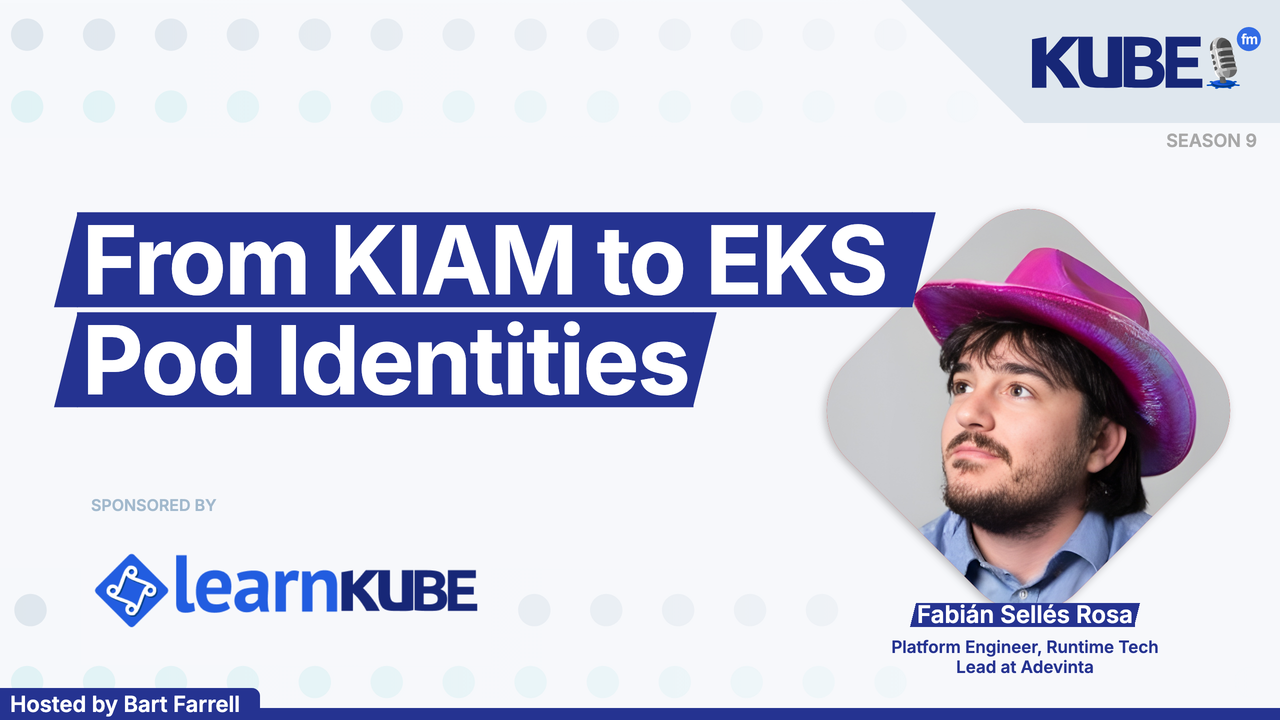
An unmaintained identity component can remain invisible until a routine Kubernetes upgrade turns it into an incident.
Fabián Sellés Rosa, Platform Engineer and Runtime Tech Lead at Adevinta, explains how his team moved from KIAM to EKS Pod Identities without discarding the security boundaries and application interface that their internal platform depended on.
In this interview:
- Why KIAM became urgent to replace after years of stable operation
- How Crossplane, a custom controller, and KRO with ACK compared against the team's criteria
- Why managed EKS Capabilities reduced toil but introduced observability and rollout trade-offs
- How Kyverno preserved namespace-level authorization for IAM roles
Kubernetes jobs
Software Engineer with Mozilla
Salary: CA$95K to CA$139K a year
Location: remote from
Tech stack: Kubernetes, Google Cloud Platform, Kubernetes, Docker, GCP, OpenTelemetry, alerting, monitoring, Sentry, Grafana
Software Engineer with Mozilla
Salary: $37 to $373.89K a year
Location: remote from
Tech stack: Kubernetes, Google Cloud Platform, Kubernetes, Docker, GCP, OpenTelemetry, Sentry, Grafana, Prometheus, Terraform
Software Engineer with Mozilla
Salary: CA$95K to CA$139K a year
Location: remote from
Tech stack: Kubernetes, Google Cloud Platform, Kubernetes, Docker, GCP, OpenTelemetry, alerting, monitoring, Sentry, Grafana
Software Engineer with Mozilla
Salary: $37 to $373.89K a year
Location: remote from
Tech stack: Kubernetes, Google Cloud Platform, Kubernetes, Docker, GCP, Terraform, OpenTelemetry, monitoring, Sentry, Grafana
Software Engineer with Mozilla
Salary: $37 to $373.89K a year
Location: remote from
Tech stack: Kubernetes, Google Cloud Platform, Kubernetes, Docker, GCP, OpenTelemetry, monitoring, observability, Sentry, Grafana
Discover more Kubernetes jobs on Kube Careers →
Code & tools
SloK: Kubernetes-native SLO operator
github.com/slok-operator
SloK lets teams define SLOs as Kubernetes custom resources, generate Prometheus rules, track error budgets, backtest SLO YAML, and view reliability trends in a dashboard.
Crust-Gather – kubectl Cluster Snapshot Plugin
github.com/crust-gather
Crust-Gather is a kubectl plugin for collecting Kubernetes cluster state and exposing it through an API server.
github.com/gerbil
KubeGUI is a desktop application that provides a graphical interface for managing Kubernetes clusters with resource visualization and management capabilities.
Okteto: Kubernetes Development Platform
github.com/okteto
Okteto is a development platform that creates production-like Kubernetes environments with live code sync, allowing developers to code directly in clusters without local setup or Docker builds.
KubeCM: Kubernetes Kubeconfig Manager
github.com/sunny0826
KubeCM lets you manage and switch between multiple Kubernetes clusters and namespaces from a single command-line tool.
It also merges multiple kubeconfig files into one and supports an interactive mode for selecting contexts.
Other interesting projects:
Upcoming Kubernetes events
Aug
6
Online meetup organized by Kubernauts Worldwide Meetup.
This is a virtual event
This is a free event.
Aug
8
In-person conference organized by COSCUP.
Location: Taipei, TW
This event requires an entrance fee
Aug
10
Run and Scale AI Applications with AKS
Online meetup organized by Microsoft Reactor Redmond.
This is a virtual event
This is a free event.
Sept
10
Online workshop organized by LearnKube.
This is a virtual event
This event requires an entrance fee


Kubernetes call for papers
expired
Kubernetes Community Days Suisse Romande 2026
The Call For Paper was open until 16 August 2026 at UTC. More info →
Location: Geneva, CH
In-person conference organized by KCD Suisse Romande.
The conference starts on the 9 December 2026.
- Apply here
expired
The Call For Paper was open until 31 August 2026 at UTC. More info →
Location: Bucharest, RO
In-person conference organized by OmniOpenCon.
The conference starts on the 18 October 2026.
- Apply here
expired
The Call For Paper was open until 14 August 2026 at UTC. More info →
Location: Paris, FR
In-person conference organized by mate.dev.
The conference starts on the 3 December 2026.
- Apply here
expired
The Call For Paper was open until 15 August 2026 at UTC. More info →
Location: Buenos Aires, AR
In-person conference organized by Cloud Security Space.
The conference starts on the 9 October 2026.
- Apply here
expired
The Call For Paper was open until 28 August 2026 at UTC. More info →
This is a virtual event
Online conference organized by ScyllaDB.
The conference starts on the 11 March 2027.
- Apply here
10
days
The Call For Paper is open until 30 September 2026 at UTC. More info →
Location: Bengaluru, IN
In-person conference organized by Canonical.
The conference starts on the 15 November 2026.
- Apply here
25
days
Global Summit on Data Science and Cloud Computing
The Call For Paper is open until 15 October 2026 at UTC. More info →
Location: Rome, IT
In-person conference organized by Noveltics Group.
The conference starts on the 20 October 2026.
- Apply here
11
days
The Call For Paper is open until 1 October 2026 at UTC. More info →
Location: Amsterdam, NL
In-person conference organized by SREDay.
The conference starts on the 2 November 2026.
- Apply here
19
days
NextGen Intelligence Conference: Data, Cloud & AI
The Call For Paper is open until 9 October 2026 at UTC. More info →
Location: London, GB
In-person conference organized by TechAI.
The conference starts on the 17 November 2026.
- Apply here
Thanks for reading.
See you next week!
— Gulcan